2023 Mexico – Tequila
Next morning, we went on a day trip to Tequila. Federika always looked for tours wherever we went, and despite hating the taste of Tequila, it sounded interesting. Our taxi driver, Lester, turned out to be a very good guide, and during the hour-and-a-half drive, he gave us a lot of information about what we would be seeing. All over the world, the only drink that was allowed to be called Tequila had to come from Tequila. Other towns were making the same drink, but they weren’t allowed to call it Tequila.
As we approached the town, we started seeing large fields of Agave plants which Tequila is made. Our first stop was a distillery where we were shown the process of how the agave was picked, cooked, cut and eventually put into large barrels where they were distilled. Next, the Tequila was put into different types of barrels for different lengths of time, depending on what product was required. At the end of the tour, a young girl gave us four different types of Tequila, ranging from the basic product to one that was ten years old, and the price varied accordingly. 
She also showed us the proper way of tasting it so it didn’t burn our mouths. Federika found it enlightening, but for me, the best method was to take it straight from the glass and flush it down the nearest toilet. No burning and no hangover. To be fair, I would do the same with the finest brandy or whisky, as I don’t like them either.
Next stop was a huge field of agave, where Lester described how it was cut and transported. 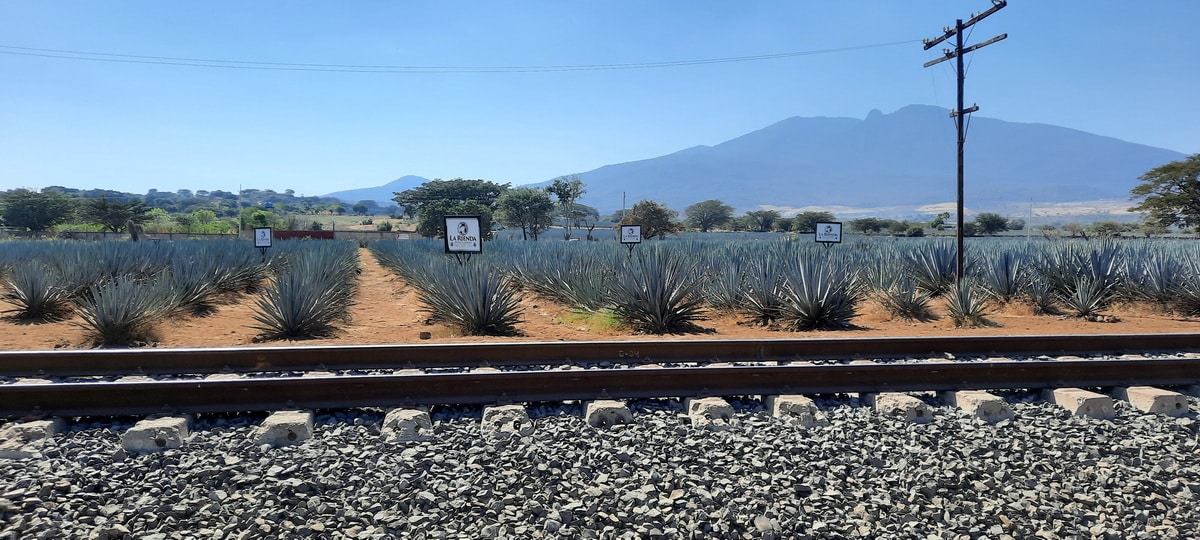
Then he left us to spend a couple of hours in town. On arrival, we saw three men climbing up a very high pole. When they got to the top they appeared to be doing nothing except winding rope around the pole. At that point, someone held a hat in front of us asking for money. I always give a few bob to street performers, but not when all they do is sit on a pole fiddling with a rope. Ten minutes later, we were just about to leave when each of them hooked one end of the rope around their ankles and hung from the ropes, which started the pole spinning slowly while the men descended upside down. It wasn’t the most spectacular event I had ever seen, and the men (who probably did it 30 times a day) looked thoroughly bored with the whole thing, but it was entertaining.
Lunch was again in the centre courtyard of an old house, and while they still served your basic tacos, they were definitely better quality than anything we had been served so far.
I always made videos of our travels, and so it is good to have a photo of anything that shows the town’s name to use as a title. Mexico was very good for that, as every town had a sign with large colourful lettering. In Tequila, a group of young kids had monopolised the sign and were charging tourists for taking photos. Good luck to them for being so enterprising, but they were getting a bit carried away, so it took ten minutes to photograph each tourist from all the different angles, including a few where the kid lay on his back and took a photo from the bottom up. We didn’t want to go through all that fuss and would have been happy to give them money to just leave us alone, but they had a mafia-like grip on the sign. We waited for a lull in the photo shoot and sneaked one in while they were negotiating with some tourists. 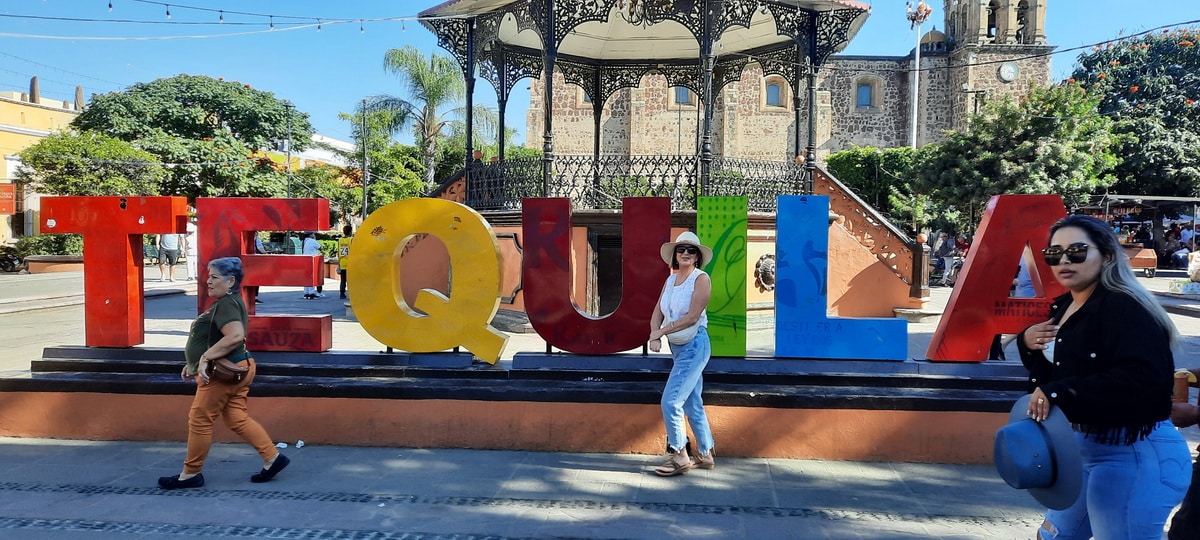
Our last stop was an amazing hotel called The Cofradia, where all the rooms were giant barrels. 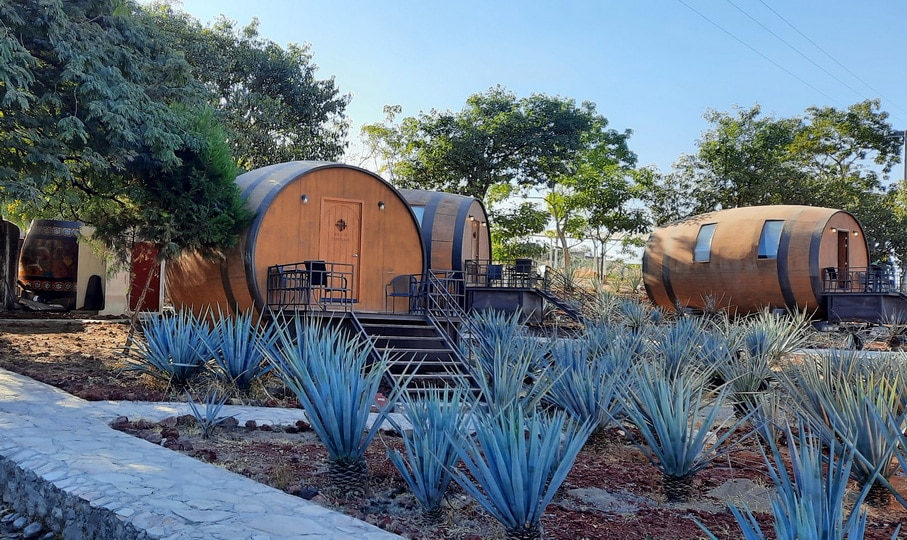
There was also an enormous underground restaurant, so I assumed they catered for big events, which would give the hotel a great novelty value for large groups. It was fun, but I wouldn’t pay so much extra for a room just for the novelty of sleeping in a barrel. The journey home took over two hours because of all the traffic, but Federika had a nice chat with the driver while I drifted in and out of sleep.
At night we went to the local town again and were surprised to see that at our first choice restaurant, La Luna, there was no queue to get in. Someone showed us to a lovely little table in the large courtyard, but as soon as I sat down, I knew I couldn’t possibly eat there. Despite being a sophisticated, high-class Mexican restaurant with an average clientele age of at least 60 years old, they were playing loud techno dance music. I had to shout to Federika to be heard, and the oppressive boom, boom, boom of the bass drum made it sound like we were on a building site. It was a lovely restaurant and I really wanted to stay, but I just couldn’t bear it, so we went across the street to where we had an excellent meal on our first day. It was half empty, and a young girl showed us to a table, but they were also playing loud dance music. Not quite as bad as the other place, but still enough to ruin a nice dinner. I really didn’t understand the logic of it. Never in the history of the world has anyone sat at a restaurant table and said, “I can’t eat here because you are not playing loud dance music.” On the other hand, there are plenty of people like us who will either leave or never return because of it. Why not play background music that doesn’t upset anyone?
On our last day, we booked a walking tour of the city, meeting in front of the cathedral. Our guide was a young Mexican who was great, but I had never known anyone with such a piercing voice. I had to stand a couple of metres away from him to stop it hurting my ears. I thought it was just me, so I was surprised to hear that Federika had the same problem. He was very knowledgeable, but went into too much detail, so it got a bit tedious at times, although we couldn’t help but like him. The highlight of the tour was a visit to the Government Palace, where there were murals by the world-famous artist Orozco. I wasn’t crazy about the murals, but Federika really enjoyed them and told me the main attraction was the symbolism. I had always been wary of anything that required arbitrary interpretation to be appreciated.
In the past, people paid for an audio tour that included headphones, which I always liked and sometimes preferred to a real-life guide. I was starting to notice people who had downloaded audio guides onto their phones and were using them without headphones, so in what should be a quiet environment, I could now hear two or three electronic guides playing at the same time. Gone is the peaceful atmosphere of these public places, to be replaced by the constant hissing of mobile speakerphones.
The tour finished with us going to an enormous food hall offering a wide variety of all things tortilla, but I managed to find some kind of goat stew, which was pretty good. The guide sat with us and gave us his life story, which ended in the present with him studying for his master’s degree in sociology.
Late afternoon, I had an email from the taxi company, which was going to pick us up at Cancun airport the next day and take us to Puerto Morelos. I was not one to panic, but the email said they had to cancel our transfer because taxis were striking in protest at the government’s decision to allow Uber in the area. There was talk of roads being blockaded, which would make it impossible for taxis and buses to get to the airport. I remembered how chaotic it was in Puerto Vallarta when we arrived with hundreds of people queueing for taxis that were working normally; what on earth was it going to be like in Cancun airport with no taxis? We were frantically trying to think of alternatives, but sometimes trying to avoid a bad situation can make matters worse.

2023 Mexico
